
 Greetings from Juergen
The strongest work in this issue would fall apart if you moved it across the street. That sounds like a limitation. I've come to think it's the whole point. These artists treat their surroundings as a collaborator with opinions — the place already had an idea, and their job was to finish the sentence rather than start a new one. Weinstein designs an eight-story glass cloud that only reads correctly under one specific atrium's light. Moment Factory tunes its cathedral scores to a ten-second acoustic reverberation, which means the building's own echo is composing alongside them.
I find this oddly comforting, maybe because so much of what I make on a screen could live anywhere and therefore belongs nowhere. A file is portable by design. A glass sculpture suspended in Manila is not. The street artists in Vidar's roundups are running the cheap version of the same wager — a hedge, a barbed-wire strand, a crack in the pavement becomes the material itself. The nature pieces hand the last move to a tide or a branch and trust it to do better than the artist would. Even Bowie's Lightroom room exists to surround you, letting the space carry the feeling.
So the question underneath the whole issue: is this kind of work humble, or is it just better at listening than the rest of us? I lean toward listening, but I won't pretend I've sorted it out. Expect five works that couldn't exist anywhere but where they are — and a nagging suspicion that portability was never the virtue we assumed.
The Intersect: Art In Tech
Subscribe to 'The Intersect: Art in Tech and Tech in Art' podcast, a companion audio feature where we explore each week's topics in a conversational format.
captivate.fm
Public Art
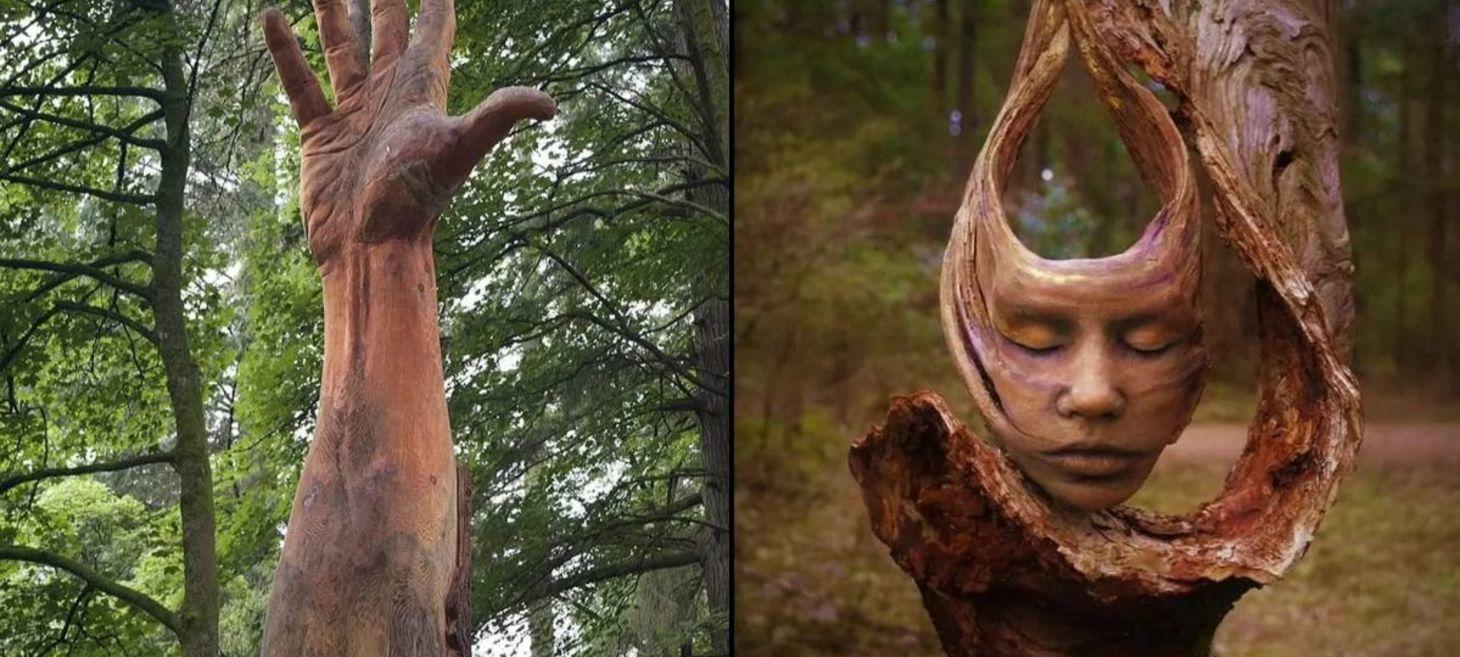
When the Tree Is the Punchline: Nature as Co-Artist
Vidar's collection over at Street Art Utopia is one of those posts that resets a lazy assumption I didn't know I was carrying. I've always filed street art under "urban" — crumbling walls, wet concrete, the occasional parking garage. So scrolling through these ten photos, something genuinely shifted. The same instinct that turns a hedge into a lion's mane works just as well when the canvas is a forest floor or a weed pushing through a crack in the pavement.
David Zinn has been making original artwork around Ann Arbor since 1987. His temporary street drawings are improvised on location with chalk, charcoal, and found objects. That means the weed isn't decoration. It's part of the raw material that tells him what the creature should become.
This issue is full of artists who treat their surroundings as a collaborator with opinions. But the nature work goes a step further than the rest. A wall holds still while you paint it. A weed with purple flowers does not — it already wants to be wild hair. Fallen leaves want to be a banded spiral around a tree trunk. The artist stops fighting the place and starts taking dictation from it.
What surprises me is how obvious it feels in hindsight. Of course a forest floor makes a better partner than a blank wall — it has its own agenda.
Which leaves the question this whole issue keeps circling, now shrunk to chalk and twigs: is that humility, or just very good listening — and where exactly does the artist stop and the place take over?
streetartutopia.com

When the City Finishes the Sentence
After leaving nature to make the last move, this issue heads into town — where the collaborator is concrete instead of tide. Another one of Vidar's roundup at Street Art Utopia is one of those posts I keep returning to, not because it's packed with theory but because it's just genuinely delightful. Ten works from Miami to Ecuador to Warsaw, each one doing something a blank wall never could: using the actual site — a hedge, a road sign, a strand of barbed wire — as the material itself. The city doesn't just host the art. It finishes the sentence.
I'll be honest: there's no obvious tech angle here, and I don't care. What I find compelling is the underlying idea — that transformation happens at the seam between two things. A living hedge becomes a blanket. Barbed wire becomes a phone line between children. The gap between what's there and what's painted is where the meaning lives. That's the same logic I find in the best generative work: the interesting stuff happens at the boundary, not in the middle.
Real barbed wire becomes the phone line between the two children, which is why the image lands so strongly: innocence and danger share the same line.
Seth's Telefòn from the Made in Haiti project is the one that stopped me cold. El Decertor's sleeping child tucked under a hedge-blanket is the one that made me smile. Both artists are doing something I deeply respect — reading a site with enough patience to see what it already wants to say. The street artist makes the same bet the cathedral projectionist does, just smaller and cheaper: the place already had an idea, and the smart move is to listen.
So is that humility, or just very good listening? It's the question that runs under this whole issue — whether handing the road sign the job feels different from handing a tool the job. Find where the seam is, and pull.
streetartutopia.com
Art and Spatial Computing
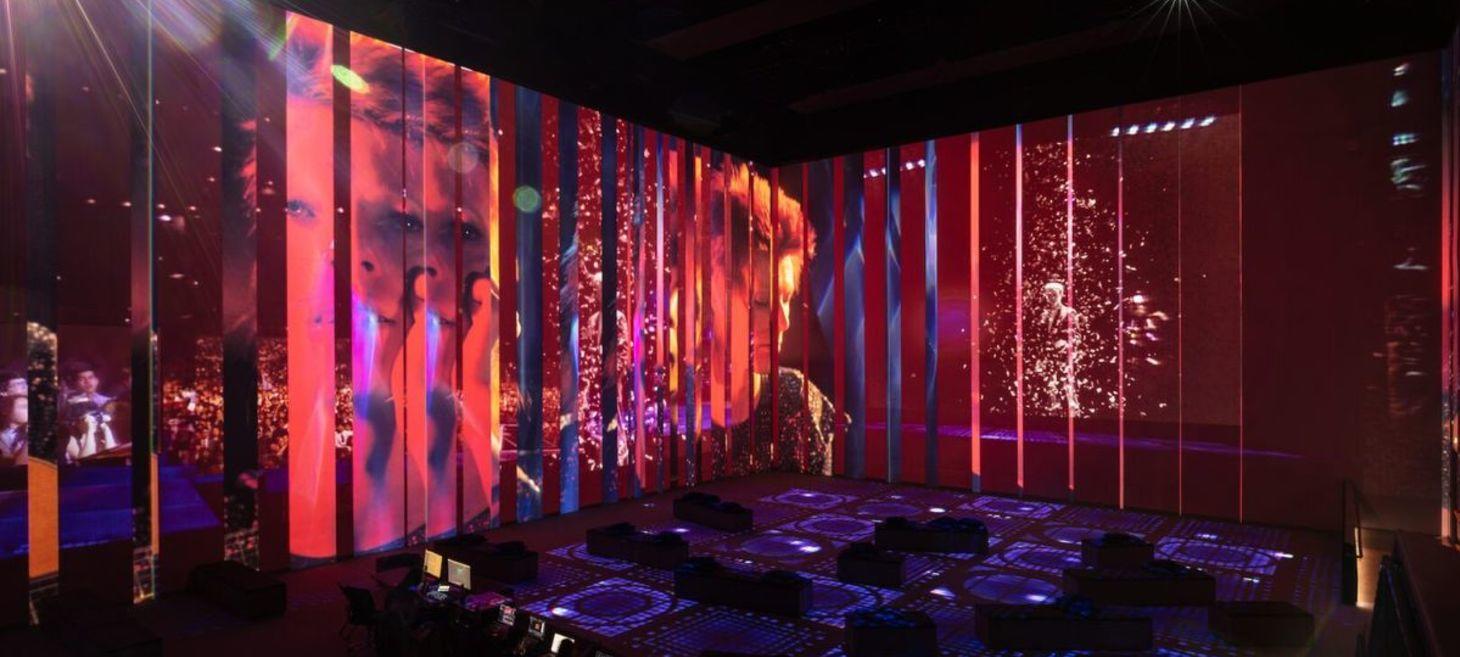
David Bowie Gets the Immersive Treatment at London's Lightroom
Aesthetica Magazine's interview with Tom Wexler, Co-Director and Designer at 59 Studio, covers the new 360° experience You're Not Alone, opening this spring at London's Lightroom in collaboration with the Bowie Estate. The show promises to pull visitors inside Bowie's creative world — from Space Oddity through Blackstar — with the stated aim of revealing "the man behind the masks" rather than just cycling through Ziggy and the Thin White Duke.
If the rest of this issue is about places that finish the artist's sentence, this one flips it. The room here has one job: to surround you. The space does the feeling, not the screen. My first reaction, though, was a smaller heresy: who decided immersive 360° experiences had to be Van Gogh or Monet? I have nothing against either. But the format has started to feel like a screensaver with a gift shop. Bowie is a different proposition. And I say this as someone who'd happily sit through 45 minutes of swirling light if it meant Heroes was playing at volume.
"Everyone has a different route in. For some it's Ziggy, others it's Labyrinth, and for lots of people it's Let's Dance or Under Pressure. And yet everyone feels that he's speaking directly to them, which is an extraordinary phenomenon."
That's Wexler describing what makes Bowie such a compelling subject for this kind of work. He's right. The format finally has a subject worthy of it.
So the real question is whether the technology serves the art or just dresses it up. Can a room full of projections get closer to a person than a well-curated archive ever could? Or are we just asking the space to do the listening, the way the cathedrals later in this issue do — and hoping it has good taste?
aestheticamagazine.com
Interactive Art
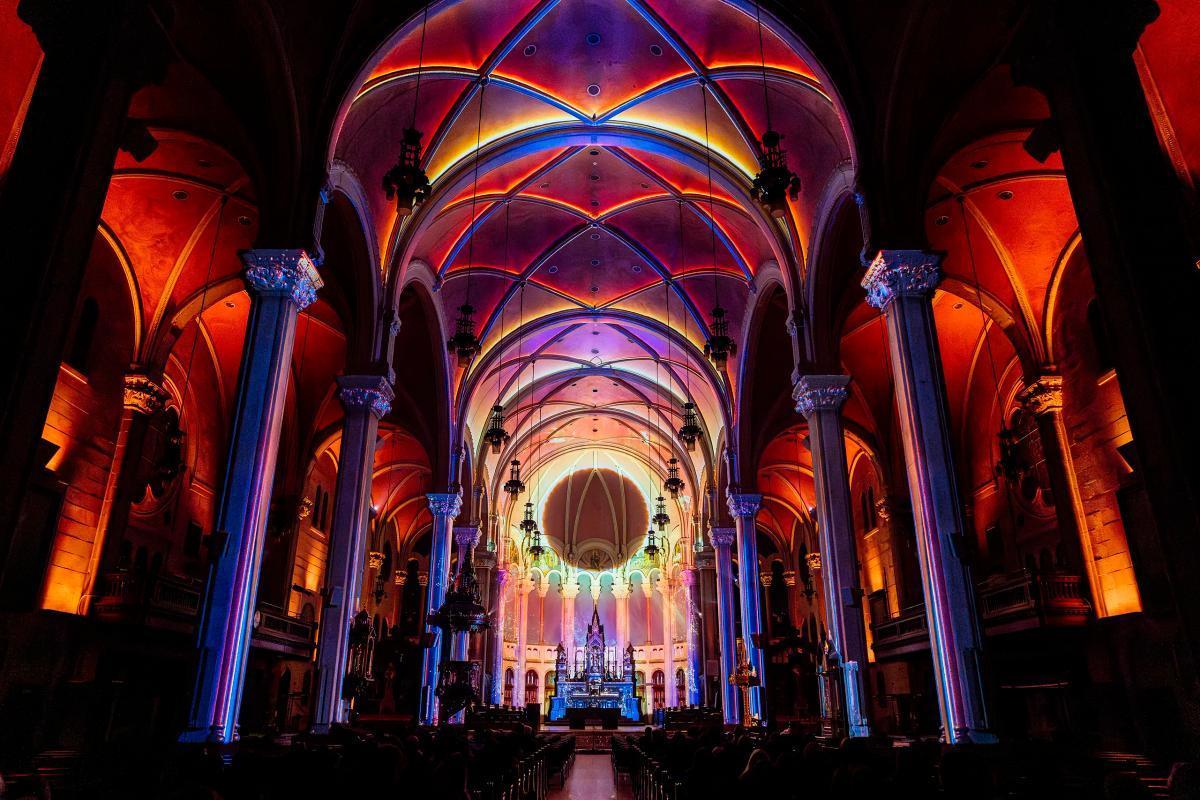
When Cathedrals Learn to Glow: Moment Factory and the Light That Touches You
A piece at urdesignmag, published under the urdesignmag byline, walks through Moment Factory's AURA series — permanent multimedia installations that turn cathedrals in Montreal, Paris, San Francisco, and Quebec City into nocturnal destinations. Projection mapping, drone photogrammetry, custom enclosures that mimic the stone so the hardware vanishes, orchestral scores calibrated to ten-second acoustic reverberations. The pitch is elegant: light that pays for the building's upkeep while drawing your eye to woodcarvings that hide in daytime shadow. Like the cathedrals in our last piece, this is work that listens to the room before it does anything — except here the listening comes wired to a server rack.
Here's what complicates this for me. A few years ago we visited the Sagrada Família in Barcelona. Late afternoon, and the sunlight came through Gaudí's glass and did something I wasn't ready for. I felt emotional, touched, slightly undone. People around me were openly crying. No projection mapping, no orchestral score, no 3D scan of the masonry. Just stone, glass, and the sun doing what it does for free. I was amazed, and I had brought nothing to that moment except being there.
Equipment is often housed in custom enclosures that mimic the existing materials of the site, allowing the hardware to disappear so the visitor can focus entirely on the sensory experience of the volume and scale.
So I sit with the tension. AURA's craft is real, and I don't doubt people feel something genuine inside it. But the Sagrada didn't need projectors to wreck me — it needed light it already had. Every work in this issue makes the same bet: the place already had an idea, and the artist just finished its sentence. AURA finishes the sentence too. I'm just not sure the cathedral had left a blank.
When the stone can already move you to tears, what exactly is the projection adding — and what might it be quietly replacing?
urdesignmag.com
Sculpture
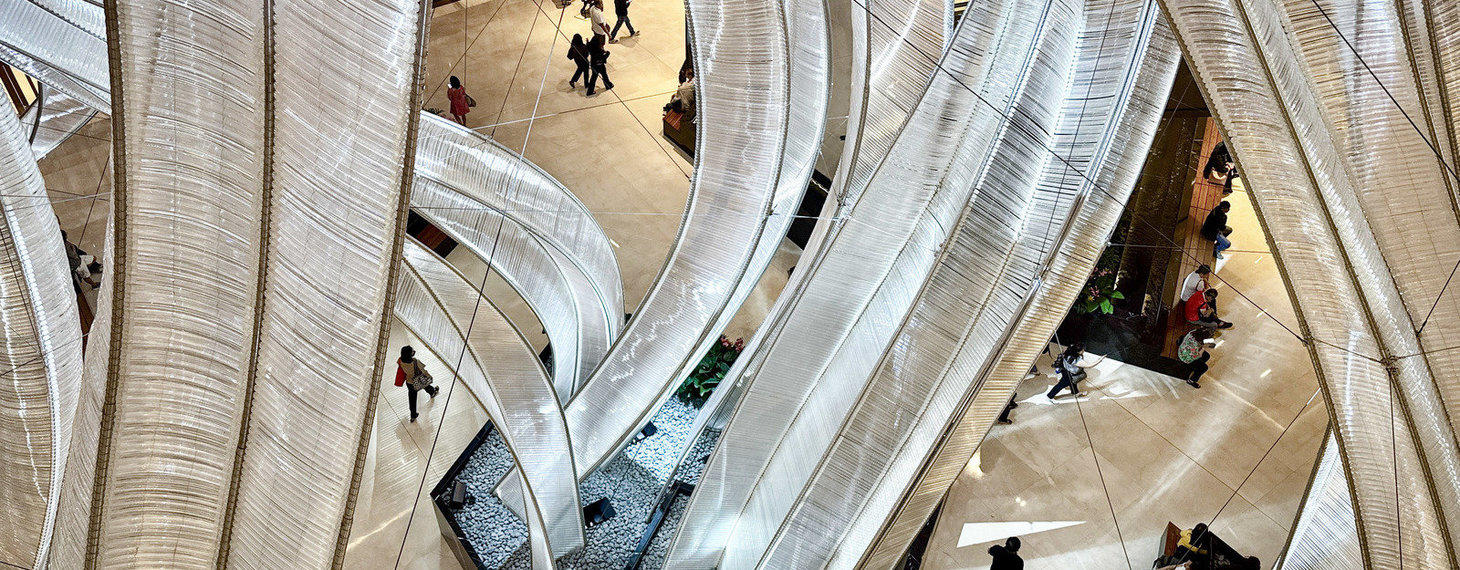
Rewarding and Harrowing: On Latitude as a Creative Catalyst
Every piece in this issue treats its location as a collaborator with opinions. So it feels right to open with the person who made me think about latitude in the first place — though here the collaborator isn't a building. It's another human being.
Heather Miller's profile of Nikolas Weinstein Studios over at Core77 walks through how an eight-story, 16,000-tube glass sculpture called Mangrove ended up suspended in a Manila atrium. Along the way, Autodesk Fusion quietly became the connective tissue between hand-woven glass and the custom machines that make it possible. It's a lovely piece about craft, parametric tooling, and that rare studio culture where designers also build the machines that build the work. But the line that actually stopped me was buried near the top.
Weinstein talks about his early collaboration with Frank Gehry, who handed a young, relatively untested glass artist an enormous amount of latitude. His description of the experience: "both rewarding and harrowing." That phrase has been rattling around in my head all week. I've lived some version of it more than once — the project that's thrilling precisely because you have no idea if you can actually pull it off. The excitement and the cold sweat are, it turns out, the same chemical.
"I lucked out," Weinstein says. "He gave me a tremendous amount of latitude, and it was, to say the least, both rewarding and harrowing."
What I find quietly moving here is what Gehry actually gave him. Not mentorship in the LinkedIn sense, but room. Room to experiment, room to maybe fail a little, room to stay safe enough that the discomfort turned productive rather than paralyzing. That, I think, is what good collaboration really is — somebody trusting you past the point where you trust yourself, and inadvertently walking you straight through your own imposter syndrome.
The rest of this issue hands that same trust to walls and tides and trees. But it started, for me, with one architect deciding to step back.
Who gave you the latitude that turned out to be the catalyst?
core77.com
 The Last Word
Thanks for spending some time with these works this week. I keep coming back to the same nagging thought: we built portability into almost everything we make, and called it progress. But the pieces in this issue can't move an inch without falling apart, and that turns out to be their whole strength. I'm genuinely curious where you land on this. Is there something you've made that only works in one place — and would you have it any other way? Hit reply and tell me. I read everything.
Best, Juergen
The Intersect: Art In Tech