Greetings from Juergen
Here's something I keep noticing: the better our tools get, the harder people seem to work to make them feel familiar. A piece of software dresses itself up as a 1970s tape machine. A retro musical instrument kit ships as a bag of parts you have to solder yourself. A drawing machine swings a pendulum for ten minutes to produce one decaying spiral that any plotter could fake in a second. None of this is accidental, and none of it is purely nostalgic.
The through-line in this issue is a paradox I haven't quite resolved. Every wave of new technology — the Moog, wet-plate photography, now generative AI — eventually summons a countermovement that reclaims whatever the upgrade quietly threw out. Ellen McGirt's Design Observer piece traces that pattern back further than I'd remembered, and once you see it, you see it everywhere. Sancristoforo's Homework borrowing Eliane Radigue's musical drone aesthetic. Ralf Jacobs framing his Harmonograph as furniture. The Music Thing Workshop Computer asking you to build the thing before you play it.
What I'm less sure about is whether these retro gestures are genuinely moving form forward, or whether they're a comfort response — a way of slowing the metabolism when the pace of change gets too brisk to digest. Probably both, on different days. Four stories this week that orbit that question without quite landing on an answer.
Artificial Intelligence and Creativity
New Technology Always Forges a New Creative Path — and Then Becomes Retro
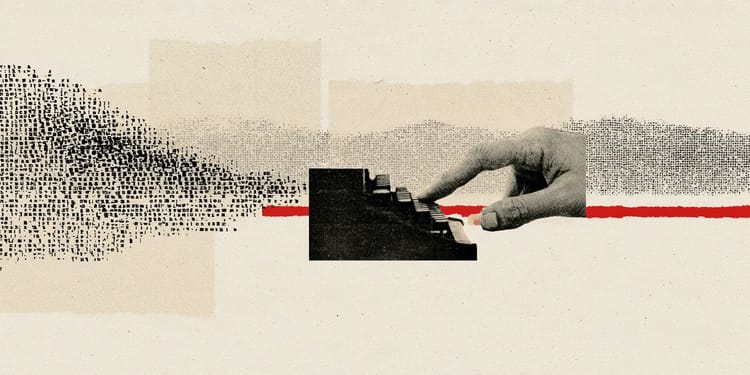
Ellen McGirt's piece at Design Observer opens with the Moog synthesizer as a kind of origin story for our current anxieties — and it's a good one. In 1964, orchestras and studio musicians treated the Moog as an existential threat. The American Federation of Musicians literally banned it from union productions. Sound familiar? Rachel Paese's framing reminds us that this particular panic has an embarrassingly long track record of being wrong.
If the previous two pieces in this issue made the case that going backward can be a form of going forward, this one zooms out and asks the obvious follow-up: how does anything end up retro in the first place? The path is depressingly consistent. In photography — a medium that has died roughly a thousand deaths (we covered a few of them in issue 77) — photosensitive plates gave way to large-format view cameras, then point-and-shoots, then digital sensors, then AI image generation. Music walked the same staircase: acoustic instruments, electronic keyboards, modular synths, DAWs, and now generative audio. Each step came with its own little funeral.
What I find quietly funny is that the Moog — once the villain of this story — is now the thing people reach for when they want to sound authentic. Artists are buying modular synthesizers specifically to make music that sounds vintage, just as photographers load expired film into old Leicas to chase a grain no algorithm has quite managed to fake. The threat becomes the texture. The disruptor becomes the heirloom.
"New technology always forges a new creative path, some of it revolutionary, some of it mundane."
McGirt is right that this isn't purely a creative conversation — it's about money and gatekeeping, about who controls the new form and who gets stranded on the wrong side of it. That part doesn't soften with time the way the aesthetic anxiety does. The union ban looks quaint now; the economic displacement underneath it never quite did.
Which sets up the question I keep circling, and which the next piece — a pendulum-driven drawing machine that moonlights as a coffee table — pokes at from a different angle: if today's AI tools are tomorrow's Moog synthesizers, what does that make the people currently refusing to touch them? Early adopters of a future nostalgia, or just early?
Art & Science
The Drawing Machine That Doubles as Furniture, Apparently
Rain Noe's piece at Core77 introduces Ralf Jacobs, a Netherlands-based artist who has built a Harmonograph — a pendulum-driven drawing machine with a frictionless hinge that gives the stylus enough momentum to trace those hypnotic, slowly decaying curves you've probably seen in physics textbooks. It's genuinely beautiful to watch. What makes it unusual is that Jacobs frames the whole thing as furniture.
I had a Spirograph as a kid, and I still have a soft spot for mechanical devices that make art without a screen involved. After a software synth dressed as a 1970s console, a DIY Eurorack kit, and an essay about every new technology eventually growing a retro shadow, a pendulum scratching out Lissajous figures feels like the logical terminus of this issue. Going backward to go somewhere new, indeed — and here we are, all the way back to gravity.
What I can't get my head around is the furniture angle. There's a vaguely table-shaped wooden form underneath the mechanism, but you couldn't actually put anything on it — because it's a drawing machine. Calling it furniture feels like calling a violin a chair because it has legs.
"Underlying my practice is the belief that art is a form of signal processing. Each work is a relic of interaction: a transmission captured, a behavior observed, a pattern retrieved from noise."
That framing from Jacobs is genuinely compelling, and I don't want to be churlish — the machine is wonderful and the outputs are beautiful. Maybe the furniture designation is the conceptual wink, the thing meant to make you pause and ask exactly the question I'm asking. Or maybe you're not supposed to "get it," and that's the point.
Which is maybe where this whole issue lands. Four objects, all reaching backward — toward patchbays, toward pendulums, toward the slower hand. I don't think any of it is mere nostalgia, and I don't think it's pushing form forward in the way the press releases want to claim either. It's somewhere in between: a wager that constraint still teaches something the frictionless tool can't. I'm not sure that wager pays off every time. But I notice I keep showing up to watch.
The Last Word
Thanks for reading this week. I'm genuinely curious where you land on the retro question — whether you're someone who solders their own modules on a Sunday afternoon, runs a tape emulator on every channel without quite knowing why, or finds the whole thing a bit precious. I keep flipping on it myself, which is probably why I wrote the issue in the first place.
Hit reply and tell me what's pulling you backward lately, and whether you think it's taking you somewhere new or just somewhere comfortable. I read everything, even when I'm slow to answer.
Best, Juergen