
 Greetings from Juergen
There's something quietly stubborn happening in studios right now, and I keep running into it.
Manabu Kosaka builds paper replicas of vintage cameras so precise that the film advance lever actually moves.
Iyo Hasegawa stacks wrenches into furniture that can be disassembled back into a toolbox.
Issey Miyake's studio turns pleating scraps into chairs.
These aren't people who ran out of conventional materials. They're people making a point — about patience, about process, about the stubborn insistence that how you make something is inseparable from what it means. I'm not sure any of them would frame it that way, which is probably why it lands.
What strikes me is that none of this is precious in the way that word usually implies. Zim & Zou reconstruct boomboxes from hand-cut colored paper — every speaker grid, every cassette reel — and it reads less like nostalgia than like a mild act of defiance. Rushera takes discarded plastic and melts it into coral-like forms, which is either hopeful or devastating depending on how long you sit with it. The materials in this issue are humble, often waste, occasionally ridiculous. The results are anything but. This week I'm thinking about what it means to resist the path of least resistance — and whether that resistance is itself becoming a kind of aesthetic.
The Intersect: Art In Tech
Subscribe to 'The Intersect: Art in Tech and Tech in Art' podcast, a companion audio feature where we explore each week's topics in a conversational format.
captivate.fm
Definitely Not AI
Wrenches as Art: The Most AI-Proof Objects in the Room
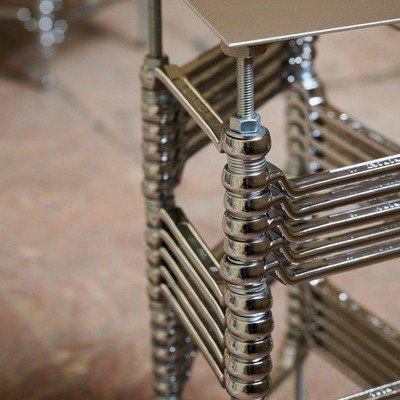
Rain Noe's piece at Core77 covers Japanese artist Iyo Hasegawa's Wrench furniture series — chairs and tables built from stacked offset wrenches threaded onto rods, held together with washers and nuts, no glue, no welding. The whole thing is reversible: disassemble it, and you've got a toolbox again.
Here's the subversive read I can't stop thinking about. We're drowning in conversation about which creative jobs AI will absorb next — graphic design, copywriting, illustration, music. And yet the one category that seems genuinely, structurally immune is anything involving a wrench. Mechanical service. Physical craft. The kind of work where the material pushes back. Hasegawa's furniture sits squarely in that territory, and I find that quietly satisfying.
The main material used in the work, the offset wrenches, is not glued or welded and is not fixed in place, allowing the wrench to "twist" freely. This flexibility enables the wrenches to be transformed into any shape. Additionally, they can be folded into a flat form for convenient storage and transportation.
If I were curating a "definitely not AI" shelf in a design gallery, this would be on it — not because it's anti-technology, but because it's rooted in material resistance, in the specific stubbornness of a tool designed for torque. The pieces are sold through Copenhagen-based gallery Adorno, which feels right for work this pleasantly obstinate.
Is the most future-proof art the kind that requires a wrench to make?
core77.com
Sculpture
Zim & Zou Turn Boomboxes and Cassette Tapes Into Paper Sculptures
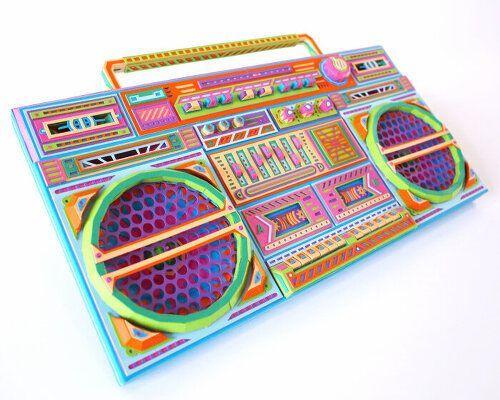
Matthew Burgos at Designboom covered something I couldn't scroll past: French design duo Zim & Zou — Lucie Thomas and Thibault Zimmermann — have reconstructed vintage boomboxes and cassette tapes entirely from hand-cut, hand-folded colored paper. Every speaker grid, every slider, every tiny reel inside each cassette tape: paper. The series is called Back to Basics II, and it's exactly as obsessive and delightful as that sounds.
We've been featuring a fair amount of "retro tech" art here lately, and I keep asking myself why it keeps showing up — and why I keep being drawn to it. There's something genuinely interesting happening when artists reach backward for the objects that technology has already discarded. The boombox is dead. The cassette tape is a novelty. And yet here they are, reborn in a medium even more fragile and ephemeral than magnetic tape.
"The series also shows a contrast between time periods because these objects come from the past, but the technique to bring them to life as handmade paper sculptures is current."
That juxtaposition — anachronistic subject, very present-tense craft — is what makes this land for me. It's not nostalgia exactly. It's more like archaeology done in the wrong material on purpose. Paper shouldn't be able to hold all that detail, and yet it does, which makes you look harder at both the sculpture and the original object it's imitating.
Is there something about living through accelerating tech cycles that keeps sending artists back to the hardware we've already outgrown?
designboom.com
Manabu Kosaka's Paper Sculptures Turn Retro Tech Into Something Uncanny
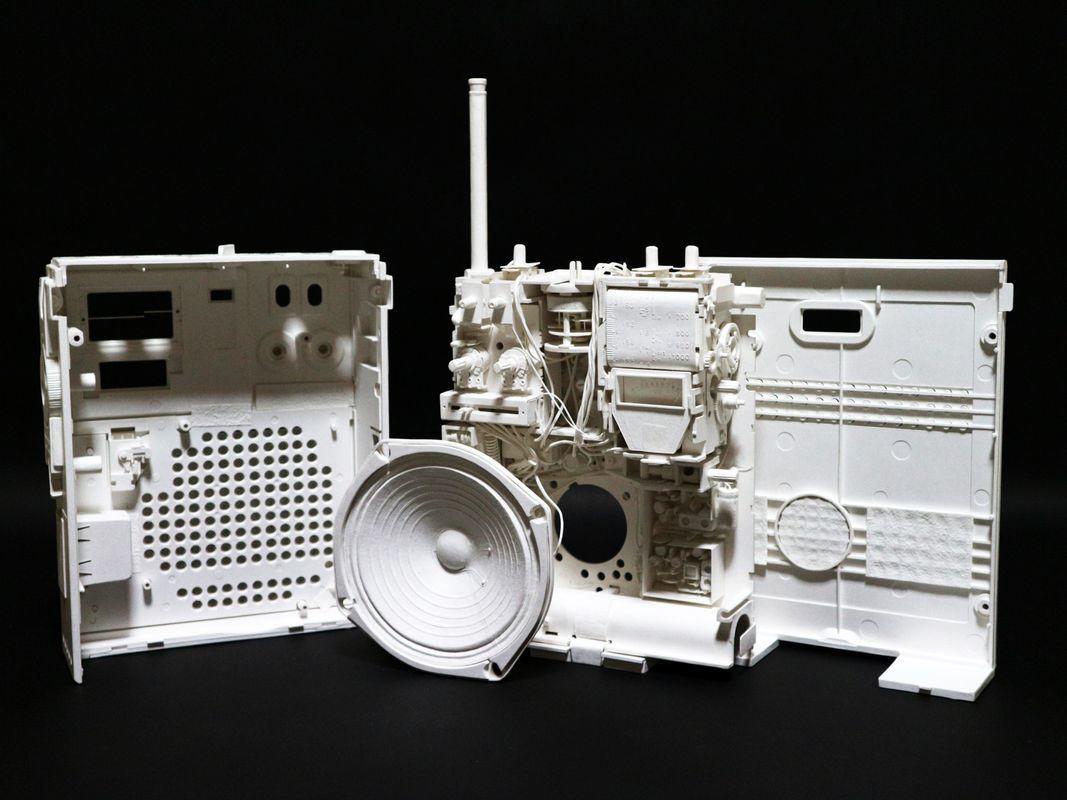
Kate Mothes' piece at Colossal introduced me to Manabu Kosaka, a Japanese artist who builds hyperrealistic scale replicas of vintage cameras, radios, game consoles, and watches — using nothing but paper. Not paper as shorthand for "simple." Paper as in: the film advance lever on his 35mm camera replica actually moves. The back hatch opens. The internal gears are in there. All of it, paper.
I've heard of the Paper Tiger, but Paper 80s Tech is genuinely a new category for me. What's interesting is that we recently featured an artist crocheting large-scale versions of Game Boys and flip phones, and Kosaka slots right alongside that impulse — this urge to render obsolete technology in a completely wrong material, slowly, by hand, with almost aggressive patience. There's something quietly defiant about it.
"What I love most about paper is its incredible flexibility. It responds to my ideas almost completely — beyond what I expect, even. It allows me to express what I want in a very direct way, while also feeling that it can become almost anything."
He's currently building a PlayStation 2, which came out in 2000 and is now apparently vintage enough to memorialize in sculpture. That detail aged me considerably.
Why do we keep reaching for soft, handmade materials to honor the hard, mass-produced objects of our childhoods — and what does it say that the replicas feel more emotionally true than the originals?
thisiscolossal.com
Sustainability in Art and Tech
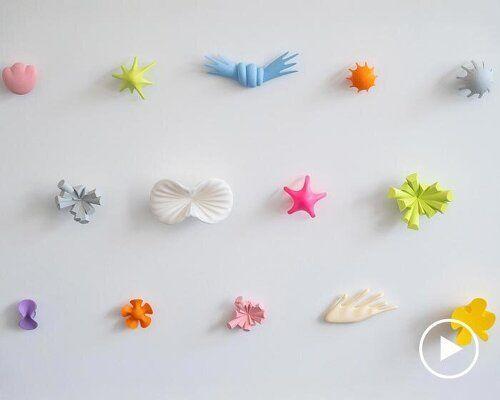
Recycled Plastic Finds Its Form in Coral-Inspired Sculpture
Eui ju's piece at Designboom covers rushera, a sculptural accessory series from Seoul-based design studio Object with Name and material manufacturer Plastic Bakery. The project takes discarded plastic and, through controlled melting, casting, and cooling, coaxes it into forms that reference coral and marine organisms — which is either a beautiful irony or a painful one, depending on your mood.
Variations in temperature, pressure, and cooling generate unpredictable patterns, which are retained as a defining characteristic of each object. This approach positions the material's inconsistency as a design parameter rather than a limitation.
This resonates with me because I work with an organization called Sugar Press Arts — they just celebrated their 10th anniversary — and their whole practice is built around recyclable, environmentally friendly papers and printing techniques. Watching them operate, I've come to believe that material constraints aren't obstacles to good work; they're often the reason good work gets made. The rushera project feels like the same logic applied to plastic waste: the imperfection isn't something to apologize for, it's the point.
The recycled-materials-as-art conversation deserves year-round attention — not just a polite nod during Earth Week — so what would it take for this kind of thinking to become the default in design, rather than the exception?
designboom.com
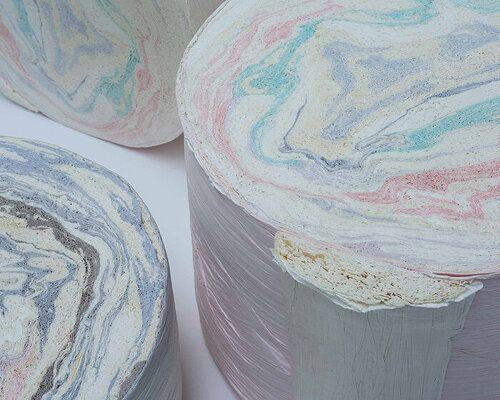
Issey Miyake Turns Pleating Waste Into Furniture Worth Keeping
Tim Spears' piece at Designboom previews 'The Paper Log: Shell and Core,' an installation Issey Miyake's MIYAKE DESIGN STUDIO and Spanish architecture office Ensamble Studio are showing at Milan Design Week 2026. The concept is disarmingly simple: those compressed 80cm paper cylinders left over from Miyake's signature pleating process — previously destined for the bin — get reimagined as furniture and sculptural objects. Each one is unique, its colors absorbed from whatever garments were being pleated that day, heat and pressure leaving a kind of accidental record.
Honestly, I find this refreshing precisely because it has nothing to do with AI. No generative models, no diffusion pipelines, no prompts. Just a sharp eye noticing that industrial byproduct looks remarkably like a tree log — and then asking what that log might become.
"The exhibition is about giving different lives or materialities to the same material, but in both explorations, we are trying to keep the memory that is structurally embodied in the paper. When we just unfold it and give it form, it still expresses the spirit of Issey Miyake."
Ensamble Studio's Shell series even draws on Michelangelo's Pietà as a reference for how folds shape form — which is exactly the kind of art-meets-materials thinking I want more of in design conversations.
What does it say about where we are that a project this quietly inventive feels almost radical?
designboom.com
 The Last Word
Thanks for reading this week. I keep coming back to this question of whether making things slowly and deliberately — with your hands, with waste, with patience — is a genuine resistance or whether it's already been absorbed into its own kind of aesthetic category. I'm not sure I know the answer, and I'm not sure I trust anyone who does. If any of this is landing differently for you — especially if you work with physical materials yourself — I'd genuinely love to hear about it. Hit reply.
Best, Juergen
The Intersect: Art In Tech